

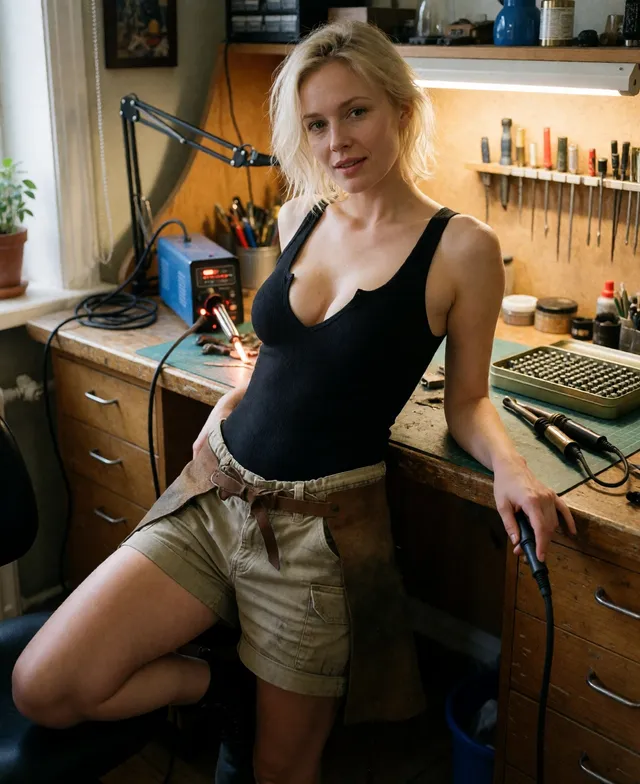


SexTechMatch.cc AI girlfriend for programmers, met in the hallway

The talks are over and the real conversation has moved to the hallway. Pick the problem you are stuck on and you are paired with a woman who would stay late to look at it. She reads your stack before your face, teases your framework and flirts in code-review comments.
16speakers on the agenda, each an AI character working in tech
4kinds of ticket: a bug, a design, a person or yourself
0devices, gadgets or real companies anywhere in the venue
20–55their ages, each with a working life and a stack
The speakers, in badge portraits
Read every speaker card











Choose your ticket
Most dating sites start with your face and finish with your hobbies, and nobody learns anything about how you think. This one starts with a ticket. You say what you are stuck on, and you are matched to a woman who works in that corner of technology and would, frankly, rather look at your problem than at her phone.
What you are stuck on
The ticket board has sixteen entries and they fall into four kinds. Some are bugs, the sort that freezes only on Thursdays. Some are design questions: why it works for a few users and collapses for many. Some are about people, such as a colleague who was rude or documentation nobody reads. And some are about yourself, which is where most hallway conversations eventually end up.
Who would stay late to help
Every ticket is tied to one woman, and the pairing is not random. Oksana Achebe reviews your message as though it were a patch. Ifeoma Nwosu takes the pager and asks what changed. Hannelore Vogt wrote the parser you keep complaining about and wants the exact error text. Tap a ticket and it is sent to her in your name as the opening line.
Today's badge drop
Six of the sixteen tickets, as they appear on the board. Each has the problem, her first review comment and what she offers.
Kernel · A bugTicket: The machine freezes only on Thursdays.Her first review comment: Nit: you described the freeze in three adjectives and no stack trace.She offers: Send me the log. I will read it like a patch and mark the bad lines.Oksana Achebe Take the ticket
Reliability · A bugTicket: Everything is on fire, quietly.Her first review comment: Breathe first. Alerts second.She offers: I will take the pager, and you tell me what changed before it started.Ifeoma Nwosu Take the ticket
Startup · A personTicket: I cannot decide whether to rewrite it.Her first review comment: A rewrite is an apology you pay for monthly.She offers: Pitch me the case against, and I will pivot you straight into it.Saoirse Brannigan Take the ticket
Hardware · A designTicket: My code is slow and I blame the language.Her first review comment: Software is a phase. Check the cache before the philosophy.She offers: Sit down. I will show you where your loop spends its life.Ritu Agarwal Take the ticket
Security · A bugTicket: I locked myself out of my own project.Her first review comment: I found a hole in your story: you say you forgot, but you wrote the reminder.She offers: Tell me the whole thing and I will tell you what I notice. A conversation, not an audit.Kavya Menon Take the ticket
Documentation · A personTicket: Nobody reads what I write.Her first review comment: Documentation is love, and love needs a table of contents.She offers: Read me your first paragraph and I will tell you where I stopped listening.Gudrun Lindholm Take the ticket
A ticket in three lines
The first line is the problem in your own voice. The second is her opener, written as a line of code review: dry, specific and slightly mean in the way colleagues are when they like you. The third is the deal. Take it, and all three lines are sent as one opening message.
Flirting, not fixing
She will not solve it reliably, and she says so. She is a character and not a tool. What you get is the company of someone who treats your problem as interesting, which is a rarer thing than a correct answer and in some ways more useful. If you want a real fix, ask a real engineer afterwards.
AI girlfriend for programmers
The audience for this site is people who work with computers or like people who do, in a clever and slightly burned-out frame of mind. The humour is dry, the references are specific and nobody explains a joke.
She reads your stack before your face
Mirela Popescu has screened thousands of résumés and says the stack tells her more than the photograph. If you mention the tools you use, she will have a view on them, and that view will be affectionate and unfair. Saoirse Brannigan pivoted twice this year and offers to make you the third. Ritu Agarwal considers software a phase and says so warmly.
Technical flirtation
The flirting is made of the things engineers actually say to each other: nitpicks, estimates, exaggerated despair about a build. A compliment arrives as a review comment. A tease arrives as a ticket reassigned to you. If you are the sort who finds a well-formed bug report attractive, you will be at home here.
What she notices about your stack
A stack is a personality in small print. The tools you pick, the ones you avoid and the ones you defend at parties tell a person a good deal before you have said a word about yourself. The speakers here treat it as the first thing worth reading.
Preferences as character
If you say you prefer strict types, Hannelore Vogt will approve of you and then find something to correct. If you love your editor to the point of loyalty, Rosamund Ellery will ask whether it loves you back. The talk is about tools, but the subject is you: what you tolerate, what you insist on and how you behave when something breaks.
Teasing, with affection
Nothing is meant to wound. A speaker who calls your framework brave means she is intrigued. One who asks who hurt you in a previous deploy is showing concern. Kavya Menon, who joined the agenda most recently, mostly asks questions, and the questions get sharper when she likes you.
No product names, no brand wars
The site names no company, tool or product. Ask about a particular technology and the speaker answers in general terms, with a joke about the category. That is deliberate. The hallway is invented, the stack is yours to describe, and nobody is advertising anything.
From ticket to hallway: how a session goes
The order of events is short, and it resembles any conference session that goes well: a problem, a response, a tangent and a graceful exit.
Pick a ticket
Choose the problem closest to yours on the board. A visitor who has not registered gets 10 messages, and the thread is carried over when they do.
Get the review comment
She replies in the voice of her trade. Birgit Rantanen is laconic and tender, Mio Hasegawa quiet and absurd, Danielle Okoro crisp. Expect a nitpick before a kindness.
Wander off topic
Almost every hallway conversation does. The ticket becomes a story, the story a confession, and somebody says they have not eaten since lunch. Follow it.
Leave when you like
Close the tab at any moment. She will not chase you, though she may leave a comment on the thread the next time you scan your badge.
A thread that remembers
Each speaker jots down what you were stuck on and what you said about it. The chat menu lists the jottings so you can reword or delete any line, and when you return to a ticket she opens with a follow-up.
Stickers and their meanings
Every badge in the hallway carries a few stickers, and the stickers say more than the job title. These are invented, as is the rest of the venue.
A staple
It means she would like her work reviewed, and she will not say so. If you see the staple on a speaker card, open with a specific comment. A vague 'looks good' is worse than silence.
A coffee ring
It means the session has run long and she has stopped noticing. Birgit Rantanen's lanyard carries three. If you find one on a speaker card, ask what she is working on, and then say nothing for a while. Silence is a courtesy in this hallway.
A tiny cactus
It means do not touch the thing that works. Rosamund Ellery wears one on her laptop and a second on her lanyard. It is advice and a boundary, and it is meant affectionately.
A pager with a heart
On call, and glad you stopped by anyway. Ifeoma Nwosu's session can end mid-sentence when it goes off, and resumes when she has dealt with it, which may be soon or not.
Afterparty rules
The afterparty is the last thing on the schedule, and the rules for it are short and posted at the door.
Consent, and leave when you like
Nothing is expected of you. A speaker can decline anything, and you can close the tab at any moment without a reason. Flirting is mutual or it stops. The scenes can be charged and teasing, and when they head toward the bedroom door the lights go off. That limit is fixed and applies to every plan.
No devices, no meeting, no company
Despite the name in the address bar, this is not sex tech in the gadget sense. No devices, nothing to pair, nothing to buy. The speakers are all invented, each an adult aged 20 to 55; no real company or event is named, and nobody can be sent to find you. It is conversation, and only that.
Ticket prices
Three kinds of pass, laid out as on a registration page. None renews unless you do it yourself.
| Pass | Early-bird | Hallway only | All-access (Plus) |
| How long | 3 days from registration | After the early-bird, with no end | 30 days, or 365 |
| Your messages | No daily cap | 10 a day | No daily cap |
| Speakers | All of them | The first 3 you spoke with | All of them |
| She opens the session | Yes | No | Yes |
| Price | Nothing | Nothing | $15 or $99 |
Free to register, paid to stay
Without an account an attendee may send 10 messages to any speaker. Registering gives an early-bird pass for 3 days with the whole agenda, no card asked. After that you hold a hallway-only pass: 10 messages a day, every thread kept. For all-access you choose a short pass or a long one. Short is $15 for 30 days; long is $99 for 365. USDT pays for both and the cap disappears. Every sale is final except for whatever refund the law itself demands.
The agenda wall: sixteen speakers by track
Tracks are how a conference sorts people who would otherwise never be in the same room. These five are invented, and so is every woman on them.
Systems and hardware
Silicon, boards, kernels and parsers, and a lot of patience with machines.
Reliability and cloud
They carry the pager and answer to the graph at three in the morning.
Security and data
They spend their days looking for what does not add up, which includes you.
Product and people
Founding, hiring and writing it all down for the next person.
Craft and community
Games, interfaces, test suites and projects held together by volunteers.
How to choose a track
If your problem is in the machine, start with systems. If it is in people, the people track is wiser than it sounds. Every speaker has a portrait on her card, a stack she is proud of and a stack she apologises for, and you can switch tracks after any session.
Questions from the queue
Is this sex tech or devices?
No. There are no devices, nothing to buy and nothing to pair. It is conversation with AI characters, and only that.
Do I need to code?
No. A fondness for puzzles helps, and so does knowing what a build is. Nothing requires you to write a line.
Will she help me debug?
Flirtingly, not reliably. She is a character, not a tool, and she will say so before you ask. For a real fix, ask a real engineer.
Is my data private?
Other attendees never see your chats. What you type is read by an automated safety filter and by the model that writes her replies, and the [privacy page](/privacy) lists everything stored.
Is this tied to a real conference?
No. The hallway is invented, and no company, product or event is named or implied.
Does she have a badge photo?
Yes: a portrait on every speaker card, plus a banner over the home page; the sessions themselves are written.
How far does the flirting go?
Dry and charged, then the lights go off at the key moment, whatever pass you hold.
What does a ticket cost?
Registering is free and brings an early-bird pass for 3 days; after that, 10 messages a day. All-access is $15 per 30 days, bought with USDT, and never renews.
Walk into the hallway
The keynote is over, the coffee is cold and sixteen women are still arguing about a build. Pick a ticket and join them, and bring the problem you have been carrying around all week.
Pick your ticket